
CYBERSECURITY ALERT: spoofed payment portal of Bogotá's water utility detected
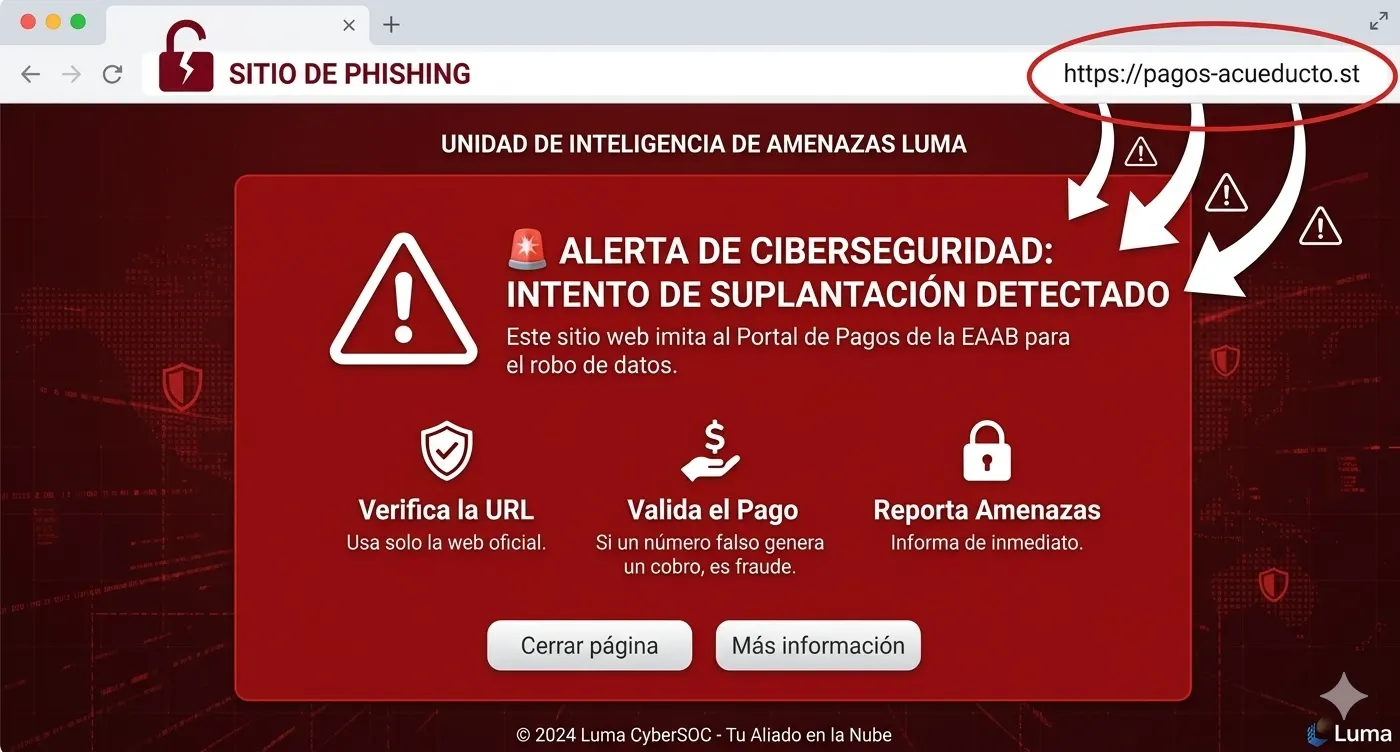
Luma’s CyberSOC team has identified an active phishing (*) campaign aimed at defrauding the citizens of Bogotá. Through a fraudulent website that perfectly imitates the interface of Bogotá’s Water and Sewerage Company (EAAB, Empresa de Acueducto y Alcantarillado de Bogotá), the attackers are capturing financial information and personal data from unsuspecting users.
How do the attackers operate?
Our technical team analyzed the malicious site and confirmed that it is an identity spoofing attack designed to deceive the user:
Fraudulent URL: The detected domain is https[:]//pagos-acueducto[.]st (Note: Do not visit this link).
No validation: The page is not connected to the EAAB’s real database. When you enter any contract account number (even made-up numbers), the system returns a random charge amount to pressure the user into proceeding with the “payment”.
Final goal: Capture credit and debit card data and banking portal login credentials.
Recommendations from our CyberSOC
To avoid falling victim to this type of fraud, we suggest following these security guidelines:
Check the URL: Make sure the address is the official one: https://www.acueducto.com.co. Be wary of domains ending in .st, .net or strange variations.
Do not use third-party links: Avoid accessing payment portals through links that arrive by SMS, suspicious emails or WhatsApp messages.
Authenticity test: As our team found, if entering a fake account number generates a “real” bill, you are on a scam site. Official portals always validate that the user exists.
Report it: If you identify a suspicious site, report it immediately to the authorities and to your IT team.
At Luma, our commitment is to protect your infrastructure and your data. Stay alert and always verify the source before making any digital transaction.
Advanced phishing using the PSE payment system as bait
What you see is an “X-ray” of how cybercriminals operate today: they no longer just copy a page, they set up an entire infrastructure to evade security.
The most critical points:
1. The infrastructure deception (trust evasion)
• Spoofing domain: They use the .st TLD (São Tomé and Príncipe). It is an immediate red flag; no government entity or public utility in Colombia would use an African extension.
• False security (SSL): Using Let’s Encrypt lets them display the “green padlock”. It is vital to remember that the padlock means the connection is private, not that the site is honest.
2. Evasion techniques (to avoid detection)
The attacker is sophisticated because they implemented measures so that security experts cannot find them easily:
• IP filtering (api.ipify.org): The site checks who is visiting. If it detects a Google bot or an antivirus company (crawlers), it shows a clean page. If it detects a real user, it triggers the attack.
• Base64 obfuscation: They hide the malicious code in a format that looks like “noise” so that basic antivirus does not recognize it as a threat.
3. Data theft (exfiltration)
This is the heart of the attack. The report indicates they are not just after your password:
• Compromised data: National ID number, mobile phone, email and bank. With this they can carry out an Account Takeover (ATO), that is, impersonate you to the bank to request loans or change passwords.
• Background capture: The application/x-www-form-urlencoded method suggests that while you think you are browsing, the data has already been sent to the attacker’s server (/w.php) before you realize it.
4. The “final touch”: legitimate redirection
So the victim does not become suspicious, the site ends by sending you to registro.pse.com.co.
• Psychological effect: The user sees that in the end they “reached the real page” and assumes there was a minor technical error, without knowing their data was stolen minutes earlier.
• Telemetry: The fingerprint.min.js file lets them know which device you use (iPhone, Android, Windows) so they can send you personalized scams in the future.
Urgent recommendations:
If you interacted with that site or entered data:
1. Preventive block: Contact your bank immediately and request that your online channels be blocked.
2. Change credentials: Change the passwords for your email and banking apps (from a secure device).
3. Two-factor authentication (MFA): Always enable app-based verification (such as Google Authenticator or Microsoft Authenticator) and avoid SMS codes, which are vulnerable to vishing.
4. Report: You can report this domain to the Colombian National Police’s Virtual CAI so it can be taken down faster.
Glossary:
Phishing: a social engineering and cybercrime technique in which attackers impersonate companies, banks or trusted people to deceive victims
.webp)
.webp)
.webp)