
Think your antivirus protects you? The most dangerous lie in cybersecurity in 2025
There is a phrase that cybersecurity experts hear with dread in board meetings: “We are already secure, we have a good antivirus and firewall installed.”
That phrase is the digital equivalent of saying: “My house is safe because I locked the door”, while you leave the windows open and have no alarms, cameras or guards.
In today’s threat landscape, where artificial intelligence designs attacks that mutate every second, traditional antivirus is dead as a sole line of defense. If your 2026 security strategy is limited to installing software and crossing your fingers, your company does not have a strategy; it has a high-risk bet.
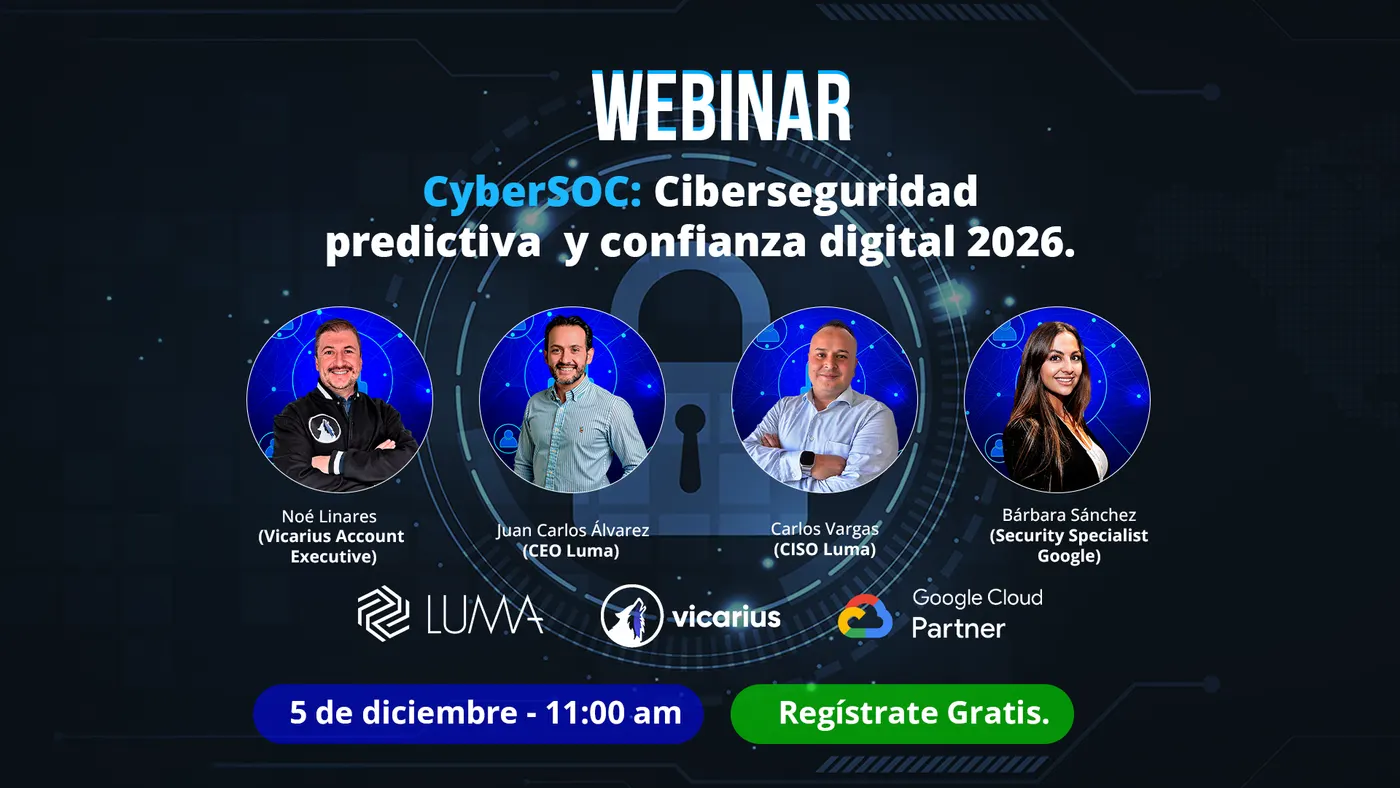
There are only 2 days left until our exclusive webinar with Google Cloud and Vicarius, and before we see each other there, we need to talk about the uncomfortable reality: Why is your antivirus no longer enough?
Learn more about the webinar here: https://lumacloud.co/webinar-cybersoc/
The problem of the “false sense of security”
Traditional antivirus works based on “signatures”. It has a list of known viruses and, if it sees one, it blocks it. But what happens when the attacker uses a zero-day (a threat no one has seen before) or uses an employee’s legitimate credentials to come in “through the front door”?
The antivirus goes blind. It sees nothing wrong.
This is where the biggest gap in companies appears: the lack of a contingency plan. When the attack inevitably gets past the antivirus, 80% of companies do not know what to do. No one is monitoring at 3:00 a.m., there are no containment protocols and there is no expert team ready to respond. The result is operational paralysis and losses in the millions.
CyberSOC: the evolution of defense
To survive in 2026, you need to stop “blocking viruses” and start “managing risk in real time”. That is a CyberSOC (Security Operations Center).
Unlike passive software, a CyberSOC is a living organism that combines:
- Predictive technology (AI): It analyzes behavior, not just files. If an accounting user tries to access engineering databases at midnight, the AI detects it as anomalous and blocks it, even if there is no “virus”.
- Vulnerability intelligence: Thanks to partners such as Vicarius, we do not wait to be attacked; we close security gaps beforehand.
- Resilient infrastructure: Backed by Google Cloud, we ensure your operation keeps running.
We answer your questions before the webinar
We know that making the leap from antivirus to a CyberSOC raises questions. Here we answer the most common ones that we will discuss in depth this December 5:
- “Is a CyberSOC only for multinationals?” False. Today, thanks to the cloud and AI, Luma offers enterprise-grade protection that is accessible to companies that are scaling.
- “Do I have to lay off my IT team?” No. The CyberSOC becomes your IT team’s best ally, taking the burden of operational security off them so they can focus on the business.
- “How long does it take to implement?” Less than you think. With cloud-native technologies, integration is fast.
The clock is ticking: see you in 48 hours
You cannot protect what you cannot see. And your antivirus is blind to modern threats.
This Friday, December 5, join the leaders of Luma, Google Cloud and Vicarius. We will show you live how predictive defense works and give you the keys to shield your 2026.
🎁 Remember: By attending, you will receive a Vulnerability Audit and 15 days of CyberSOC for FREE. Stop assuming you are secure and start validating it.
Your contingency plan starts by registering here: BOOK MY SPOT IN THE WEBINAR
.webp)
.webp)
.webp)