The 2024 Windows outage: how do you avoid a third-party systems failure?
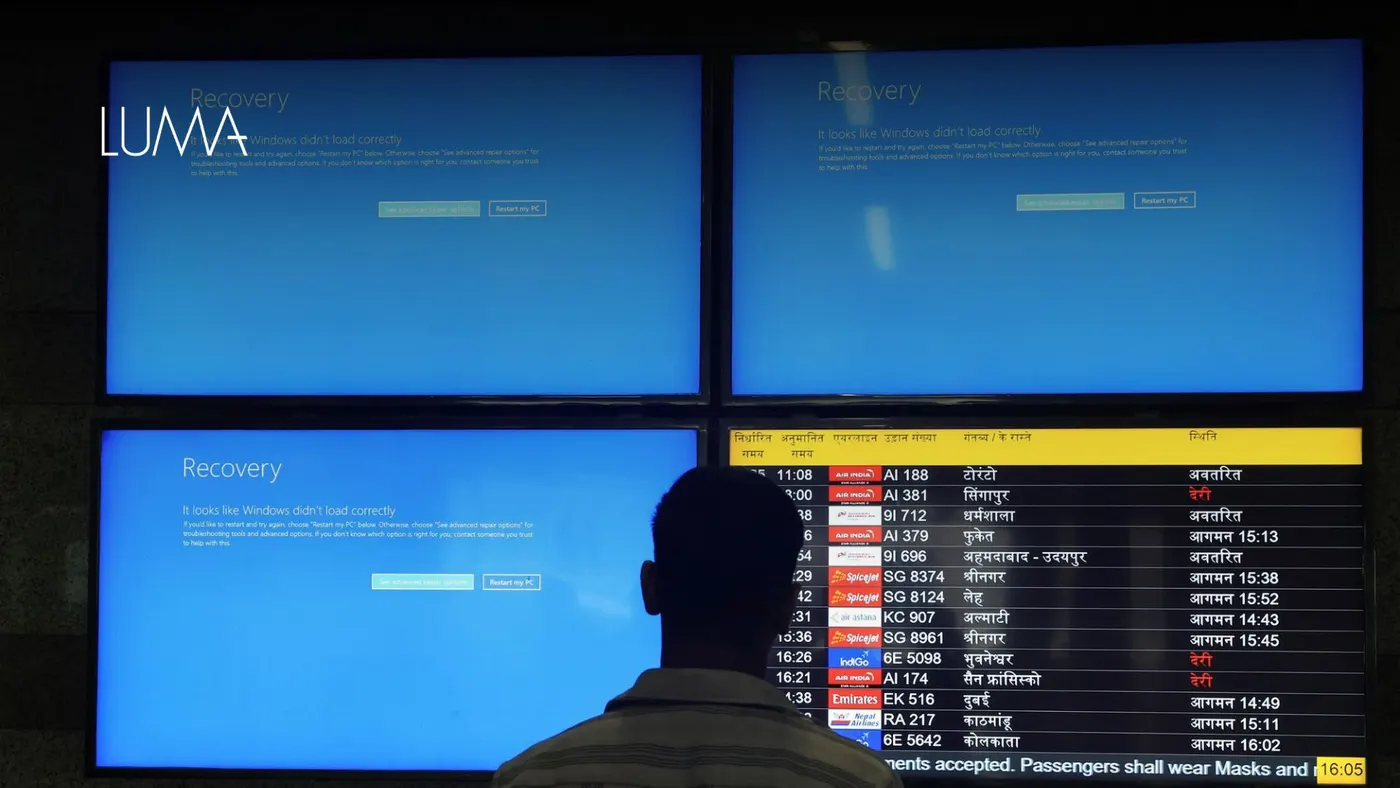
Friday, July 19, 2024 began like any other day, but within minutes it became the scene of the biggest IT crisis in history. Suddenly, airport screens in many parts of the world went from showing itineraries to displaying Windows’ dreaded “blue screen of death” (BSOD). Planes could not take off, doctors lost access to their patients’ medical records in the middle of treatment, banking platforms stopped processing payments.
What exactly happened that day? There was no cyberattack, no virus and no hack. The origin of this global chaos was a faulty update to a configuration file sent by a cybersecurity provider operating at the kernel level of the Windows operating system. When they received the automatic patch, more than 8.5 million corporate servers and computers entered an endless reboot loop they could not get out of.
This historic event showed an uncomfortable reality: your company can have the best servers and a brilliant IT team, but it is still exposed to a catastrophic systems failure if your providers’ tools fail.
How do you avoid collapse when the failure is not in your hands?
When the error comes from a Microsoft update, your security software or your main ERP, it seems there is nothing you can do. However, in infrastructure engineering there are key strategies to create a “shield” and prevent an external failure from paralyzing your operation:
1. Cascading deployments (staging policies)
The big mistake of 2024 was applying updates massively and automatically. To protect yourself, no critical update should be installed directly on production servers. Every patch should first be tested in an isolated environment (sandbox) for 24 or 48 hours before its final deployment is authorized.
2. Modular, decoupled IT architecture
If you depend on a single rigid ecosystem, the failure of one component will bring everything down. By designing modular infrastructure, you can isolate critical services. That way, if employees’ computers fail, the core of the business (such as your ERP or databases in a private cloud) will keep working and remain accessible.
3. “Out-of-band” recovery and backups
In the 2024 outage no data was lost — remote access was. Your continuity plan must include backups and management consoles that operate on a completely independent network. If your main infrastructure collapses, your team will have an alternative, secure channel to restore operations within minutes.
LUMA’s approach: designing for continuity
At LUMA we know that in the world of technology there is no such thing as zero risk. Developers make mistakes, systems go down and providers fail. That is why our philosophy is not to cross our fingers and hope nothing fails, but to build resilient infrastructure that withstands the impact when something unexpected happens.
We mitigate the risk of a systems failure through:
- Hyperconverged infrastructure: If a server or node in our cluster suffers a software or hardware error, resources and information are automatically redistributed within milliseconds to keep your operation online without your users noticing.
- Dedicated private clouds: We design tailored environments for your most sensitive systems (such as your ERP or CRM), isolating them from massive automatic third-party updates and guaranteeing single-digit latency (2 to 10 milliseconds) thanks to our local presence in Colombia.
- Technical support and proactive administration: At LUMA you are not a ticket number at a foreign call center. We have local expert engineers who preventively monitor the logical behavior of your infrastructure to detect and mitigate anomalies before they affect your business.
How prepared is your company’s architecture to withstand a third-party failure? Share your thoughts in the comments or send us a private message. Our engineering team is ready to give you strategic advice and a complete infrastructure assessment.
Sources consulted for this analysis:
- Microsoft Official Blog: Helping our customers recover from the July 2024 IT outage (https://blogs.microsoft.com/blog/2024/07/20/helping-our-customers-through-the-crowdstrike-outage/)
- TechCrunch Infrastructure: How a faulty security update grounded flights and disabled global servers (https://techcrunch.com/2024/07/19/crowdstrike-outage-how-a-faulty-update-disabled-the-world/)
- Uptime Institute: Analyzing the systemic risks of cloud and software dependency in modern enterprises (https://uptimeinstitute.com/resources/asset-profiles/outage-analysis-and-it-resiliency)