
The «spillover effect» in healthcare: when a cyberattack overwhelms your neighbor
There is a dangerous corporate myth in the healthcare sector: “If our clinic has good cybersecurity, we are safe.” Medical and statistical reality shows exactly the opposite. Today, a cyberattack is not an isolated IT problem; it is a public health problem that spreads through geographic proximity.
This phenomenon is known as the “spillover effect”.
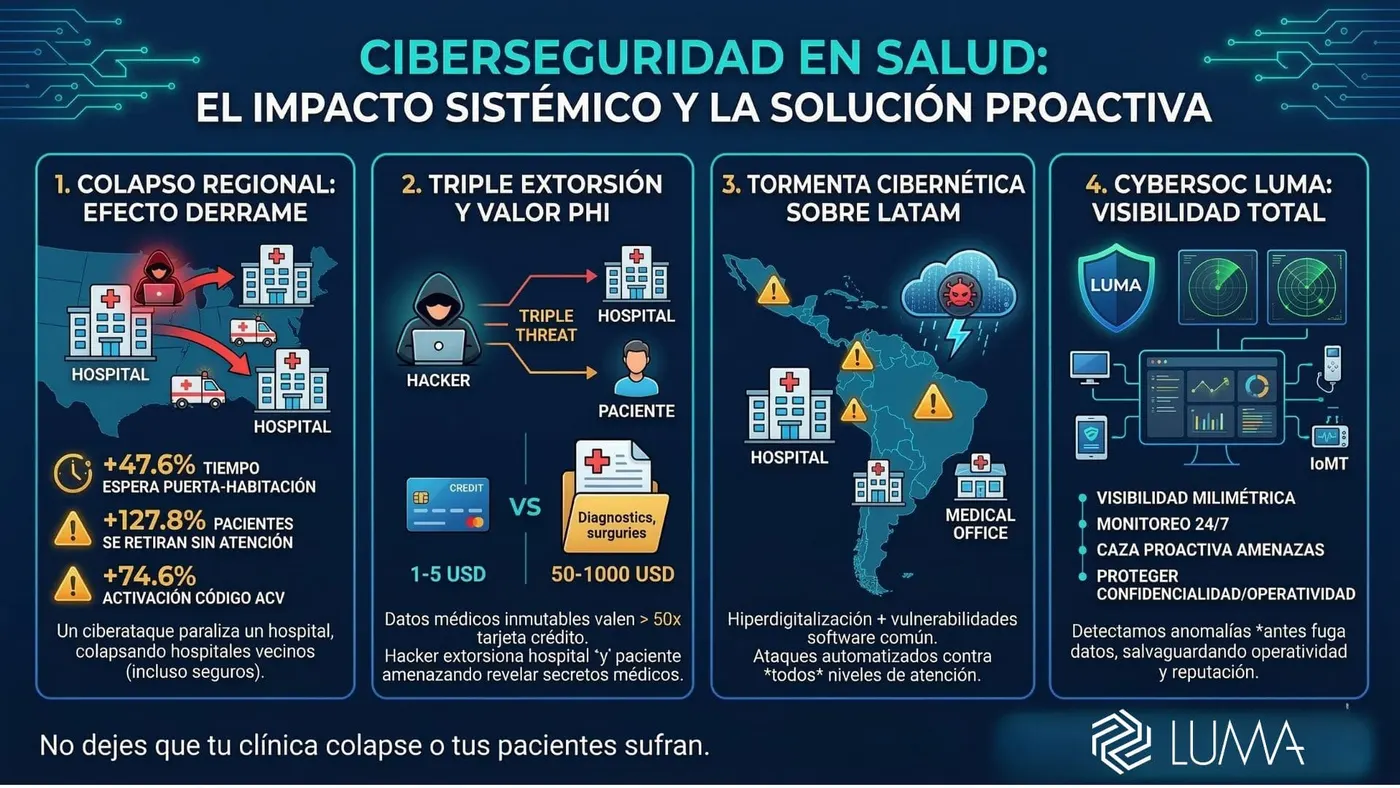
A forensic study of a massive cyberattack on a healthcare network in San Diego, CA, United States (2021) revealed the following: neighboring hospitals — which were not hacked — collapsed. When the breached hospital’s emergency room closed, ambulances were massively diverted to adjacent clinics. The result in the “safe” hospitals?
- • +47.6% increase in waiting time (door to room).
- • +127.8% increase in patients who left the emergency room without being seen.
- • +74.6% increase in stroke code activations, driving up mortality due to lack of timely care.
If your competitor’s or neighbor’s clinic goes down, your emergency room will collapse in less than 24 hours.
1. The perfect storm: from the large hospital to the private practice
As recent reports from global firms such as Deloitte and risk analysts warn for 2026, the healthcare sector faces a “perfect storm”. The attack surface has expanded brutally.
Modern cybercrime operates like an industrial franchise. It uses “copy-paste” methodologies. If they discover that a vulnerability works to infiltrate a specific radiology software at a small clinic, they automate the attack to hit every medical practice and hospital in LATAM that uses the same software.
2. The evolution of extortion: the patient as a direct hostage
In emblematic incidents (such as the Vastaamo psychiatric clinic in Finland or cancer centers in the United States), criminals bypassed management and sent emails directly to patients. The threat was clear: “Your clinic was breached. Pay 500 dollars in Bitcoin or we will send your medical history to your employer and publish it on the internet.”
Why does this blackmail work? On the Dark Web, a complete medical record is worth up to 50 times more than a credit card.
An HIV treatment, an addiction record, a psychiatric history or an undisclosed cosmetic surgery are immutable data. When a hospital fails to protect its databases, it exposes itself to multi-million class actions for destruction of reputation, moral damage and negligence in the custody of sensitive data.
3. Total visibility: the only antidote to collapse
Facing this reality with tools from the past is negligent. Modern defense is not about building higher walls, but about turning on the lights inside the network.
At LUMA, we understand that in healthcare, downtime is measured in lives and data loss is measured in destroyed reputation. Our state-of-the-art CyberSOC provides pinpoint visibility and 24/7 monitoring of your infrastructure. We hunt anomalies in real time, detecting unusual traffic before the attacker manages to exfiltrate a single medical record.
👉 Protect your patients: book a meeting today.
-
The Vastaamo case (triple extortion of the patient): * Study: When data breach hits a psychotherapy clinic: The Vastaamo case. Publication: Journal of Information Technology Teaching Cases (2024). Link: https://journals.sagepub.com/doi/10.1177/20438869241258235
-
The cost of medical data (PHI): Report: Cost of a Data Breach Report (multiple editions through 2023/2024). Author: IBM Security.
-
Latin American landscape and the perfect storm: Report: El sector salud frente a ciberataques. Author: Deloitte LATAM. Link: https://www.deloitte.com/latam/es/services/consulting/perspectives/sector-salud-frente-a-ciberataques.html
-
Future risks in the clinical ecosystem: Article: Sector Salud: Ciberataques 2026, Riesgos y Protección. Source: CiberSafety. Link: https://cibersafety.com/sector-salud-ciberataques-2026-riesgos-proteccion/
-
Impact on practices and independent physicians: Article: Ciberataques en salud: Hospitales, médicos y consultorios bajo riesgo (Parte 1). Source: AiPocrates Blog. Link: https://aipocrates.blog/2026/02/15/ciberataques-en-salud-hospitales-medicos-y-consultorios-bajo-riesgo-parte-1/
.webp)
.webp)
.webp)