
The Grinch is digital: why cyberattacks spike when you turn off the office lights
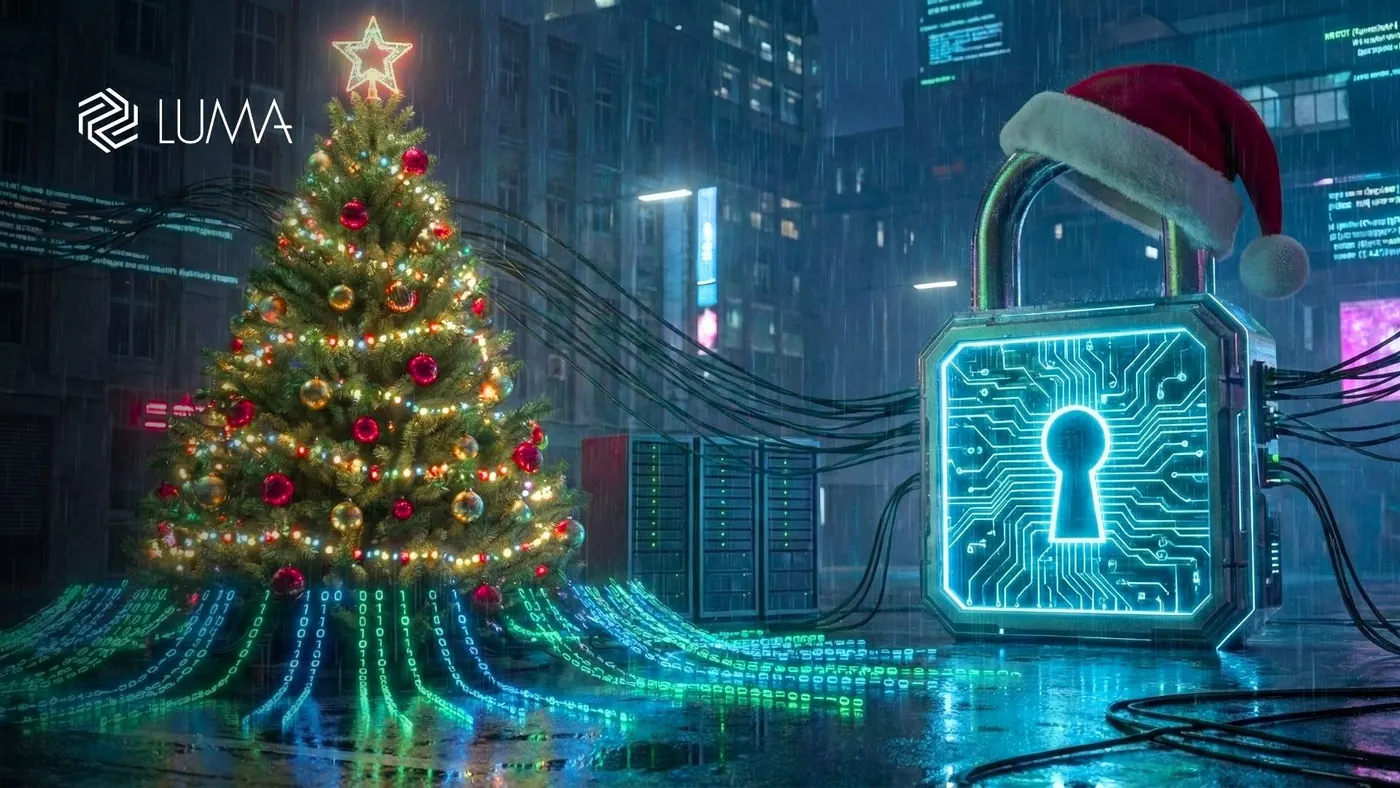
It is December 24. It is 7:00 PM. Your IT team is having dinner with their families. The General Manager’s phone is on “Do Not Disturb”. The offices are empty and the servers hum quietly.
It is the perfect scenario. But not for resting — for attacking.
Statistically, year-end holidays and long weekends are cybercriminals’ favorite moments to launch ransomware and fraud campaigns. The criminal logic is simple: companies’ Mean Time to Respond (MTTR) is much slower at Christmas.
What would normally be detected and contained in 15 minutes on a Tuesday in October can go unnoticed for 48 hours in December, giving enough time to encrypt your entire infrastructure.
Today, just days before the end of the year, at Luma we want your only concern to be what to eat for dinner, not how to rescue your data.
Here are the 3 threats you should watch this week:
1. The “phantom bonus” scam (holiday phishing)
The festive mood lowers our cognitive defenses. Attackers know this and launch massive email campaigns impersonating HR or Management.
- The hook: An email with the subject “Christmas Bonus Approved” or “Your Amazon digital gift card”.
- The risk: The excited employee clicks the malicious link, handing over their credentials to the corporate network.
- Prevention: Warn your team today: If it is too good to be true, it is phishing. No bonus is downloaded as a .zip.
2. “CEO fraud” (deepfake vishing)
With artificial intelligence, cloning an executive’s voice takes seconds.
- The scenario: Your CFO receives an urgent call or WhatsApp audio on December 26. It is “your voice” (or the CEO’s) asking for an immediate transfer to a supplier to “lock in 2026 prices”.
- The risk: The urgency and the unusual date lead people to skip verification protocols.
- Prevention: Set up a “keyword” or unbreakable security protocol for transfers during the holidays.
3. Silent ransomware
Many modern attacks do not detonate immediately. Hackers get in days before, disable network-connected backups and wait for the lowest-traffic day to encrypt the servers.
- The risk: Waking up on January 2 to a black screen demanding Bitcoin for your databases.
- Prevention: The golden rule of cyber recovery. Your backups must be immutable (they cannot be deleted or modified) and disconnected from the main network.
Your year-end checklist (before you turn off the lights)
Do not leave today without checking these 3 critical points with your technology team or security provider:
- Emergency patching: Make sure all critical systems have the latest security updates installed.
- Access cleanup: Revoke access for former employees or temporary suppliers who are no longer active. They are common backdoors.
- The “panic button”: Who has the authority to “flip the switch” if something happens on December 25? Define the emergency call chain.
Cybersecurity does not take vacations, but you should be able to.
Peace of mind does not come from ignoring risk, but from knowing you are prepared to face it. At Luma, our CyberSOC and cyber recovery systems stay on guard to monitor, detect and respond, letting you close 2025 knowing your company will be intact in 2026.
Happy holidays and a safe time off.
.webp)
.webp)
.webp)