
One employee, one PDF and a chain attack that paralyzed an entire company for over a month
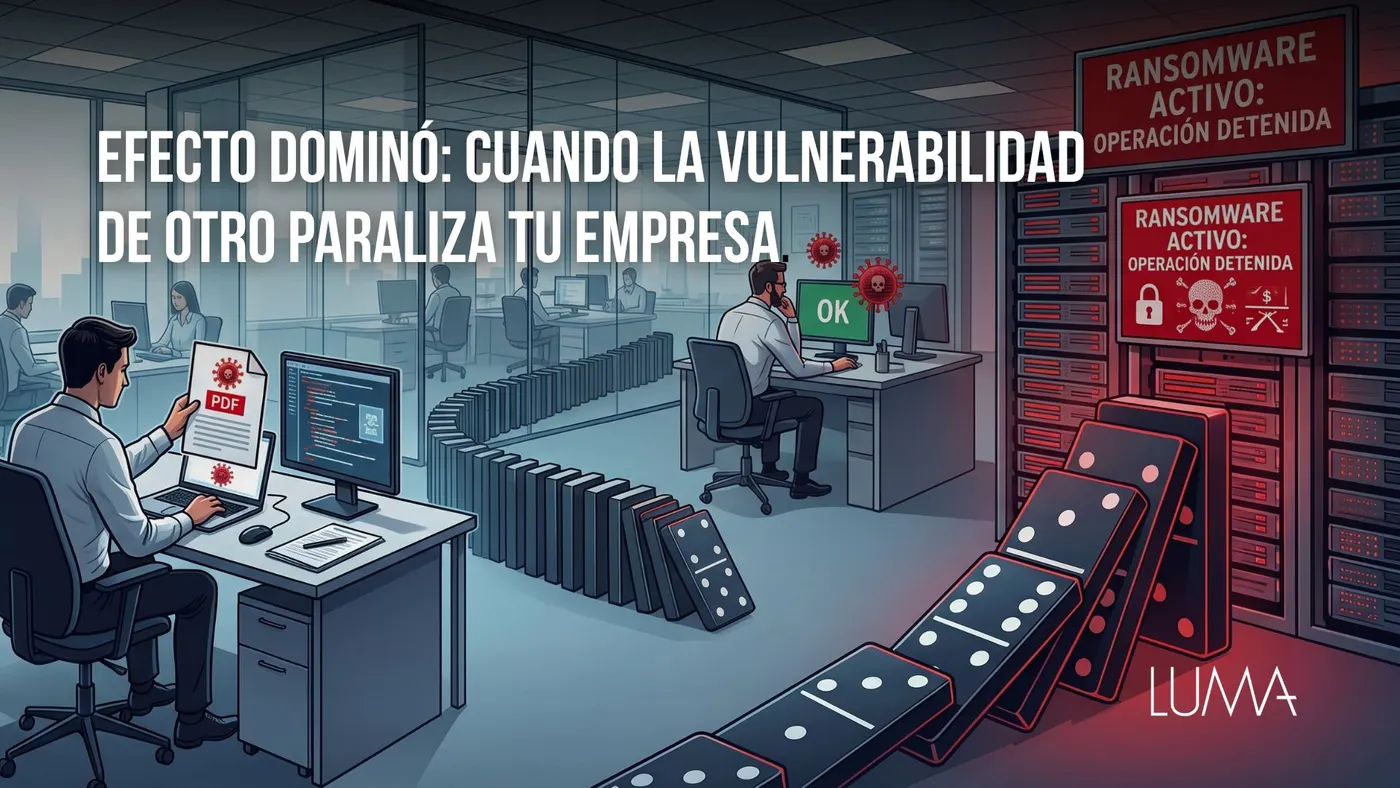
It all began with a simple email and a false sense of security.
An employee had their personal email open on their corporate computer. A message appeared in their inbox from the Human Resources department of their previous employer. The sender was legitimate (the company’s real domain) and the subject mentioned an important document: proof of a pending payment from their severance settlement.
Without hesitating, the employee downloaded the attached PDF. When they tried to open it, they noticed strange behavior on their computer and immediately realized it was a virus. Frightened, they quickly notified the IT manager at their current company.
The technical team’s response was the one many IT leaders still give today: “Don’t worry, the antivirus must have already blocked it.”
That was the mistake that cost them a whole month of operations.
The anatomy of a “chain attack”
Intrigued by the incident, the employee contacted their former employer through another channel to warn them about the email. The answer they received revealed the true scale of the threat: weeks earlier, their former employer had been hacked. The cybercriminals had taken full control of its corporate email servers.
This was not simple phishing (identity spoofing). It was a chain attack (known in the industry as island hopping).
In a chain attack, cybercriminals do not attack their final target directly. Instead, they breach a company with weak security measures and use its legitimate infrastructure (emails, suppliers, software) as an “anchor” to infect customers, suppliers or, as in this case, the new companies where former employees of the breached company work.
Dwell time: the virus that slept in the servers
The current company’s IT manager blindly trusted their traditional antivirus. But the modern malware deployed in a chain attack is designed to evade signature-based defenses.
For weeks, the malware operated silently (a concept known as dwell time). Through the local network, it jumped from the employee’s computer until it reached the crown jewels: the physical servers located on the company’s premises.
The antivirus detected the initial anomaly in the PDF, but did not understand the network behavior or the attacker’s lateral movement. Weeks after the download, the time bomb went off.
The physical servers were completely encrypted. The databases, the network-connected backups and the accounting software became inaccessible. A message demanding a multi-million ransom appeared on the company’s screens.
The company had to stop its operation completely for almost a month, facing losses in the millions, reputational damage and a crisis of trust, not to mention complaints from former employees who did not receive their severance payments on time.
3 critical lessons from this story
This scenario repeats itself every day in Colombia and around the world. It leaves operational lessons that no company can ignore in 2026:
1. Traditional antivirus is not enough against complex attacks
An antivirus reacts to what it already knows. In a chain attack, cybercriminals use real credentials and seemingly legitimate traffic. If you do not have behavior detection technologies (EDR/XDR) and continuous monitoring, you are blind to threats that are already inside your network.
2. Bad practices open the door
Allowing personal email on corporate machines without a Zero Trust policy or network segmentation means connecting the risks of employees’ private lives directly to the company’s servers.
3. Not having a cyber recovery plan (DRP) is signing a death sentence
This company’s biggest mistake was not getting infected; it was having no way to get back up. Trusting that “physical” servers are untouchable is a myth. If your backups are on the same network and you do not have secondary infrastructure or a cloud disaster recovery plan (DRP), a successful attack means your business comes to a complete standstill.
Do not be the next link in the attack
Cybersecurity today is not about avoiding being attacked, because eventually it will happen. It is about having a comprehensive strategy that combines active protection and a cyber recovery capability so fast that an incident cannot stop your operation.
Are you sure your current infrastructure could survive a chain attack, or are you relying on a false sense of security?
Let’s audit your resilience. Let’s talk expert to expert about how to protect your servers and ensure your business continuity.
.webp)
.webp)
.webp)