12,000 attacks in 48 hours and a cloned portal: how we shielded a transport terminal's operation
The recent cyberattack on Bogotá’s water utility (Acueducto de Bogotá) showed that criminals no longer just want to take servers down; they prefer to clone official payment gateways to divert companies’ legitimate revenue. For critical infrastructure that handles millions of transactions, being “blind” to these perimeter threats is not an option.
This is the story of how one of Colombia’s most important transport terminals went from having no monitoring at all to neutralizing massive attacks in record time, thanks to the pilot of our CyberSOC.
The starting point: human capacity overwhelmed
The terminal operated under a reality common to companies in the country: an internal team of just 5 people (network, security and operations administrators) supported by external support. Without active 24/7 monitoring, visibility into logs and real-time traffic was humanly impossible.
The risk was not small: a total shutdown of logistics and of national transport operations.
Incident 1: 12,000 brute-force events in 48 hours
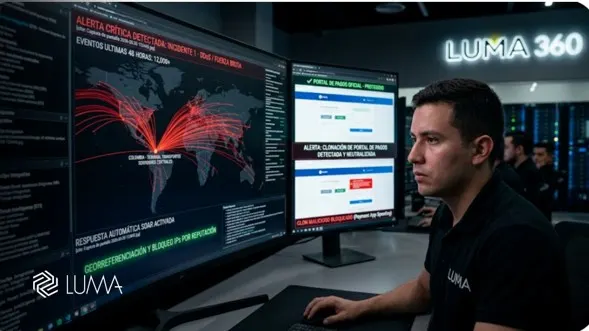
Within the first 48 hours of our CyberSOC trial, attackers launched a massive offensive: 12,000 login and saturation attempts (DDoS) from multiple countries aimed at the central servers.
How do you handle that volume of alerts without collapsing?
- The Google effect: Through Google SecOps, our platform identified the anomalous patterns in record time.
- SOAR automation: Automatic geofencing playbooks and immediate IP blocking based on reputation (reputation scoring) were activated.
- The result: The DDoS attack was mitigated before it affected the availability of a single terminal service.
Incident 2: the payment app “clone” (payment app spoofing)
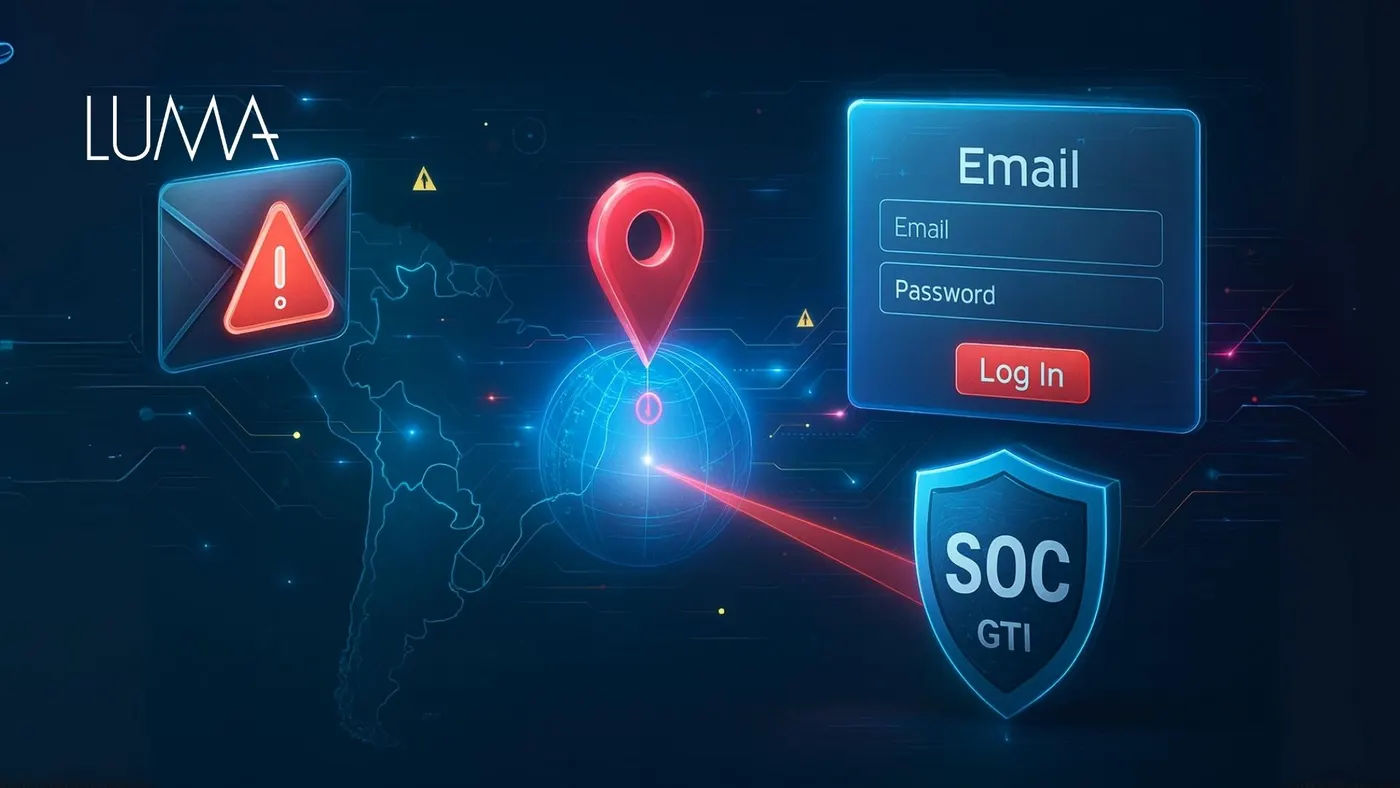
While the DDoS attack was being contained, the most dangerous and silent threat was detected: attackers deployed a malicious clone of the terminal’s official payment gateway. The goal was identical to the water utility case: steal passengers’ financial data and divert the money.
LUMA’s response was swift:
- Instant detection: Using Google Threat Intelligence (GTI), the fraudulent domain was identified the moment it appeared.
- CyberSOC intervention: The team immediately blocked the diverted transactions and cut communication with the malicious server.
- Zero losses: Fraud worth millions was avoided and downtime of the legitimate application was prevented.
From a blind infrastructure to a CyberSOC
This real case shows that manual audits or PDF reports delivered the following month are useless when an attack happens in seconds. Today, this critical infrastructure has gone from uncertainty to proactive 24/7 monitoring and continuous hardening of its web applications.
Would you like to get this same demonstration and measure your infrastructure’s real resilience at no cost? Leave a comment below with the words «DEMO CYBERSOC» and we will contact you to activate your demo and make visible what your team cannot see today.
.webp)